
















The new high-performance alloy for precision parts
Sitomb® combines the advantages of stainless steel with the cost-effectiveness of the die-casting process.
In contrast to stainless steel, which can only be processed using complex steel investment casting, Sitomb® can be produced cost-effectively using die casting.
Also available for prototypes and small series:
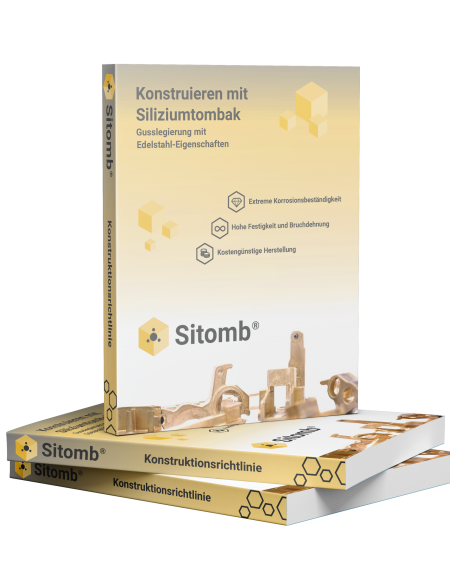
Download now for free the construction guideline!
Cost-effective production
Die Herstellung im Druckgussverfahren sorgt dafür, dass pro Zeiteinheit viele Teile hergestellt werden können. Somit fallen vergleichsweise geringe Stückkosten an.
High strength and elongation at break
Strength properties up to 700 MPa are possible. In any case a minimum of 500 MPa is guaranteed. Despite this excellent strength characteristic, high elongation values of >10% are reached before the part breaks.
Maximum corrosion resistance
Sitomb® workpieces are particularly resistant to corrosion due to the high copper content of 80%*.
*More detailed technical information on Sitomb® can be found in our design guidelines.
When is Sitomb® used?
Mainly in these situations:
Parts resulting from steel investment casting are too inaccurate or expensive
Parts resulting from Metal Injection Moulding (MIM) are too inaccurate, expensive or brittle
Parts resulting from zinc alloy die casting reach too low levels on strength and break in the long-term
The corrosion resistance of the existing detail is insufficient
Other reasons for the use
The brass that is used is too soft
Slip properties have to be improved
Antibacterial characteristics are required
Silicon tombac – Sitomb®
Sitomb® is the result from decades of alloy development and process improvement at BREUCKMANN. With specific limitations in the tolerance range for alloy elements of silicon tombac complying with DIN EN 1982 (2.0492.05, C87800, CC761S) and targeted micro alloying, we were able to achieve the metallurgical optimum for our characteristics.
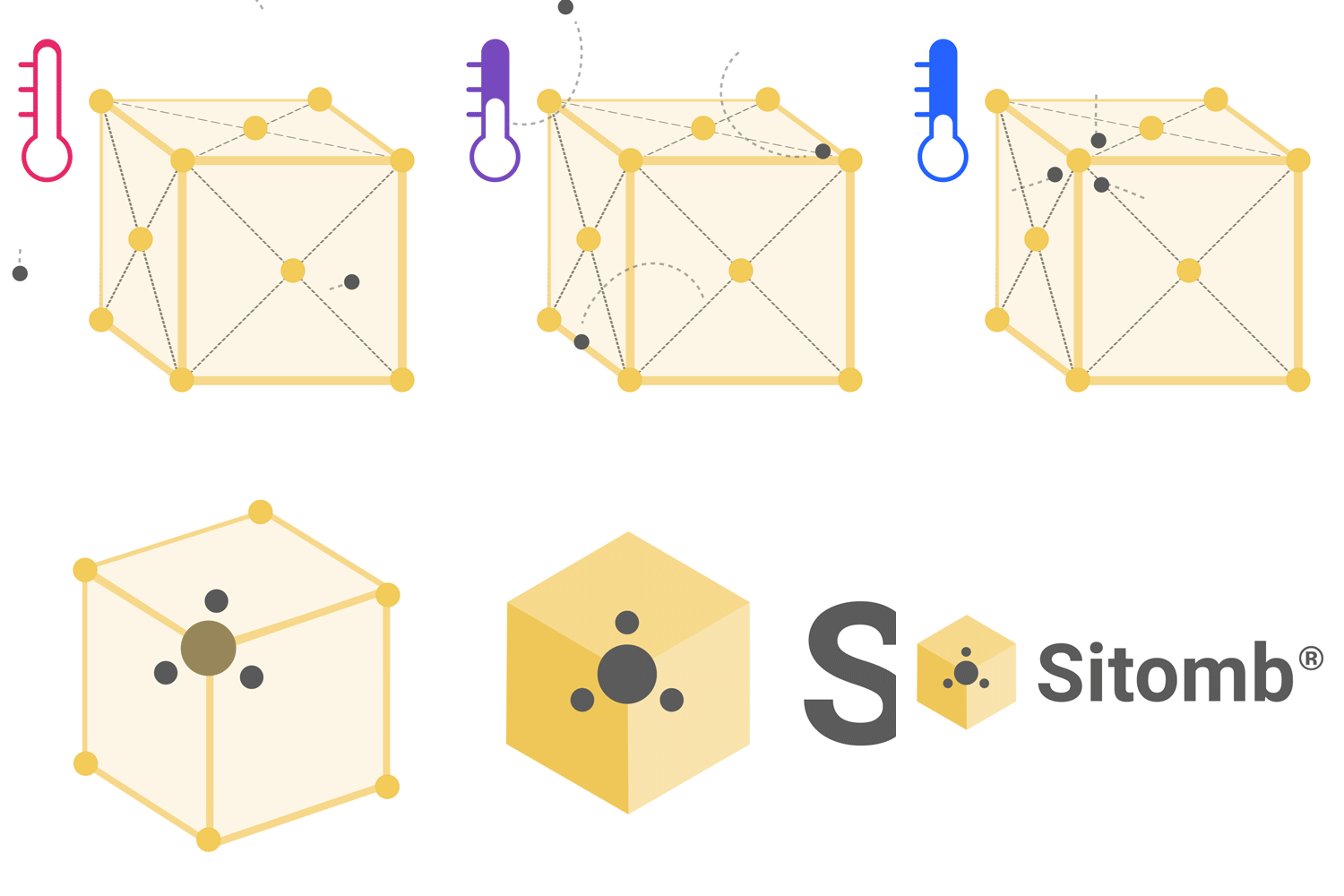
To produce Sitomb®, brass is mixed with silicon and then cooled extremely quickly. At high temperatures around 1000°C silicon is able to move freely within the metal lattice. As soon as the metal cools down to room temperature, the silicon atoms get stuck in specific positions within the interstitial metal lattice. Subsequently, they tense up the structure which results in higher hardness and strength of the component.
A similar behavior can be observed when carbon is added to steel.
The fast solidification leads to a fine grain structure having good mechanical characteristics. Additionally, using silicon for alloys results in an unusual behavior during the local extension when cooling down (avoidance/reduction of casting porosities).
How can I order my customized part made of Sitomb®?
Prototypes
Sample part made from rapid Sitomb®: hinge for a piece of furniture.
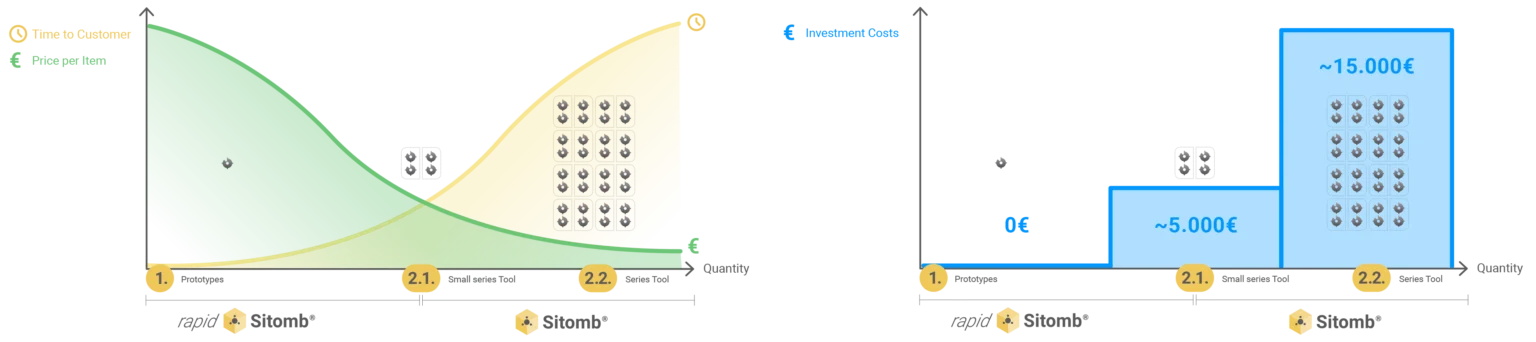
To get a first impression of our material, it is possible to order an individual prototype. We refer to this process as “rapid Sitomb®“. It enables you to order first samples without the initial investment of a die casting tool.
- Simply upload your 3D model online
- Receive your price immediately
- Complete the ordering process online
Series production
To fully benefit from the advantages of Sitomb®, a one-off investment in a die-casting tool must first be made. In relation to the quantity you need, one can choose between a small series die casting tool and a series die casting tool.
Feel free to contact us using the form below.
Series production with Sitomb®